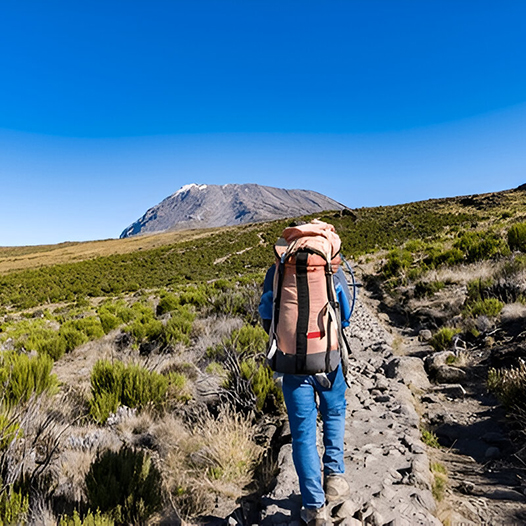
High-altitude trekking comes with undeniable risks. On Mount Kilimanjaro, altitude sickness is the single biggest factor determining whether you reach the summit — or have to turn back.
Altitude sickness does not care about your age, gender, or peak fitness level. Because the mountain rises so rapidly, symptoms are common, and there is no concrete way to predict how your body will react until your boots hit the trail.
Understanding how your body adjusts to lower oxygen levels — and recognizing the critical warning signs — is essential for a safe, successful climb.
The Science: Oxygen, Air Density & Your Body
Acclimatization is the natural process by which your body compensates for the lower availability of oxygen at higher elevations. At sea level, oxygen makes up roughly 21% of the air around us, compressed by an atmospheric pressure of about 760 mmHg. As you climb Kilimanjaro, that percentage stays the same — but the air density drops. Because molecules are spaced much further apart, you take in significantly less oxygen with every single breath.
Think of your progress in terms of an Acclimatization Line. If your body is adjusted to 3,000m on day one, pressing to 3,500m causes minor adjustments. Pushing directly to 4,000m without rest breaks that line — guaranteeing severe symptoms that can only be reversed by descending below where the sickness started.
Recognizing the 3 Levels of Altitude Sickness
1. Acute Mountain Sickness (AMS)
AMS is the initial pathological impact of ascending into thin air too quickly. It generally presents in three stages of severity:
2. High Altitude Pulmonary Edema (HAPE)
HAPE occurs when fluid builds up inside your lung air sacs, preventing oxygen from crossing into your bloodstream. This is a critical, life-threatening emergency.
Watch for: Severe breathlessness at rest, tight chest, suffocation when lying down, wet cough producing white or frothy fluid, rapid irrational behaviour.
Protocol: Administer emergency oxygen if available. Evacuate the climber via stretcher immediately.
3. High Altitude Cerebral Edema (HACE)
HACE is caused by fluid retention that leads to severe swelling of brain tissue within the skull. It frequently develops rapidly during the night.
Watch for: Blind-spot headaches unresponsive to painkillers, hallucinations, total disorientation, and complete loss of physical coordination (ataxia).
Protocol: Treat as an absolute emergency. Do not wait for sunrise. Descend instantly under darkness and seek immediate clinical care at the mountain base.
Preventative Medications: The Role of Diamox
Acetazolamide (commonly known as Diamox) is a prescription prophylactic medication used to safely speed up your body's natural breathing adaptations. It acts as a mild diuretic, causing your kidneys to excrete bicarbonate — safely increasing blood acidity and tricking your brain into forcing deeper, faster breathing cycles, even while you sleep.
Crucial Limitation: Diamox is a preventative tool, not a cure. It will not mask or fix severe symptoms once AMS has fully set in. Never use it to force an ascent if you are already sick.
Testing Protocol: Consult your physician. Take a 2-day trial dose at home two weeks prior to your flight to rule out unexpected drug interactions.
Common Side Effects: Frequent urination and a harmless tingling sensation in fingers, toes, and face. Drink extra fluids to prevent kidney stones.
⚠ Medical Disclaimer
The high-altitude data provided across this website is structured purely as an educational resource. It must never be used or relied upon for formal self-diagnosis or direct medical treatment. This content does not establish a patient-physician relationship and should not replace professional consultations, physical checkups, and personalised high-altitude clearances from a certified medical expert.
Quick Takeaways
How to climb smart and stay safe on Kilimanjaro.
Go slow. "Pole pole" gives your body time to adapt.
Choose longer routes. 7–8 day routes dramatically increase your success rate.
Hydrate relentlessly. Drink 3–4 litres of water daily.
Listen to your body. Severe dizziness or vomiting = descend immediately.
Consider Diamox. Use under medical supervision to aid acclimatization.
Elevation Zones
Kilimanjaro
High Altitude 2,500–3,500m — Breathing rate begins to alter
Very High Altitude 3,500–5,500m — Lava Tower (4,600m) is a key acclimatization test
Extreme Altitude Above 5,500m — Blood O₂ saturation drops toward 80% near summit
Lake Louise Scorecard
Professional operators track your vitals twice daily using a pulse oximeter alongside the Lake Louise Scoring System.
| Score 3–7 | Mild to moderate AMS |
| Score 8+ | Must descend immediately |
| SpO₂ below 75% | Forfeit summit push |
| Monitoring frequency | Twice daily |